.avif)

.avif)

That was the question facing the GAA (Gaelic Athletic Association) in the 1990s.
Before we dive in, a quick note: this is the first edition of TrakPro's Toolbox Talks, a new monthly series where I'll unpack the stories behind buildings and projects that have something worth learning from.
I'm kicking things off with one of my favourite places in Ireland:
Croke Park
By the 1990s, Croke Park had already been over a century in the making.
The site started life as a garden orchard on Jones's Road before becoming the City and Suburban Racecourse in the 1890s. The GAA began hosting Gaelic games there in 1884.
In 1908, former GAA President Frank Dineen bought the grounds privately to safeguard them for the Association. In 1913, the GAA finally took ownership.
What followed was decades of piecemeal growth.
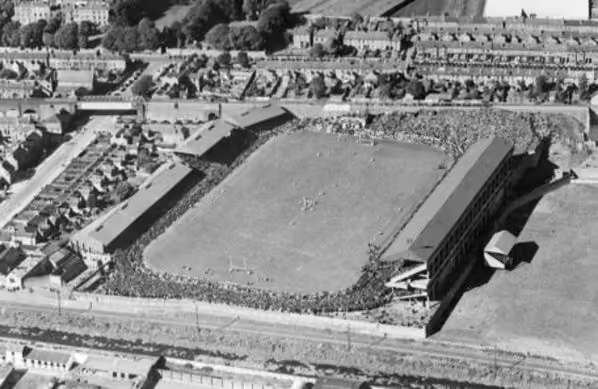
Wooden terraces in the 1920s.
A new Hogan Stand in 1959.
Hill 16 rebuilt in 1988 after overcrowding concerns following the 1983 All-Ireland Final.
By the early 1990s, Croke Park was the spiritual home of Irish sport, but structurally it was still a patchwork.
The GAA needed to transform it into a modern stadium fit for the next century.
There was just one problem.
The All-Ireland Finals could not move. Not once. Not for a single year.
So they did something extraordinary.
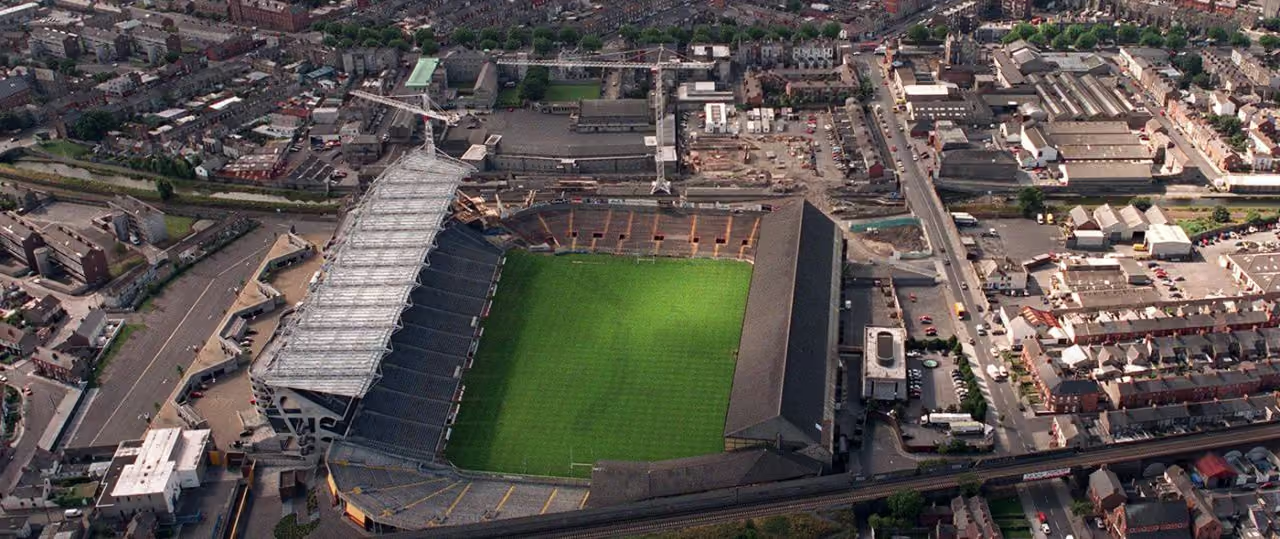
Over 14 years and four phases, Croke Park was rebuilt into an 82,300-capacity stadium while continuing to host the biggest days in Irish sport.
The Cusack Stand came down and was rebuilt.
Then the Canal End became the Davin Stand.
Then the Hogan Stand.
And finally Hill 16.
Each phase was delivered inside a live, operational venue that simply couldn't afford to go dark.
Imagine the coordination that took.
Subcontractors working around a championship calendar. Materials staged so 80,000 people could safely walk past them on a Sunday. Variations and cost control managed across more than a decade and through multiple economic cycles.
By the time redevelopment finished in 2005, the stadium had been transformed without missing a single All-Ireland Final.
That's the real lesson of Croke Park.
The best construction stories aren't always about the finished building. They're about the discipline of delivering complexity over time without disrupting the people who depend on it.
Most projects aren't stadiums.
But most projects do have constraints that can't move:
- A tenant still occupying the building
- A deadline that won't shift
- A budget that won't stretch
The teams that succeed are the ones who can see every phase, every payment, and every variation clearly across the lifecycle of a project.
That visibility is what TrakPro was built for.
Next month: another build, another lesson. Follow along if you'd like it in your feed.
P.S. Up the Royals! 🟢 🟡